Friday, September 10, 2010

Anti-colonial Canadian Past

Dinesh D'Souza has published a brilliant analysis of the President's worldview and political agenda entitled, "How Obama Thinks" (Forbes, September 27, 2010 [yes, it's how magazines date things]). His thesis is that, "the anticolonial ideology of Barack Obama Sr. is espoused by his son, the President of the United States"

Anticolonialism is the doctrine that rich countries of the West got rich by invading, occupying and looting poor countries of Asia, Africa and South America. As one of Obama's acknowledged intellectual influences, Frantz Fanon, wrote in The Wretched of the Earth, "The well-being and progress of Europe have been built up with the sweat and the dead bodies of Negroes, Arabs, Indians and the yellow races."

Anticolonialists hold that even when countries secure political independence they remain economically dependent on their former captors. This dependence is called neocolonialism, a term defined by the African statesman Kwame Nkrumah (1909--72) in his book Neocolonialism: The Last Stage of Imperialism. Nkrumah, Ghana's first president, writes that poor countries may be nominally free, but they continue to be manipulated from abroad by powerful corporate and plutocratic elites. These forces of neocolonialism oppress not only Third World people but also citizens in their own countries. Obviously the solution is to resist and overthrow the oppressors. This was the anticolonial ideology of Barack Obama Sr. and many in his generation, including many of my own relatives in India.


Obama Sr. was an economist, and in 1965 he published an important article in the East Africa Journal called "Problems Facing Our Socialism." Obama Sr. wasn't a doctrinaire socialist; rather, he saw state appropriation of wealth as a necessary means to achieve the anticolonial objective of taking resources away from the foreign looters and restoring them to the people of Africa. For Obama Sr. this was an issue of national autonomy. "Is it the African who owns this country? If he does, then why should he not control the economic means of growth in this country?"
What came immediately to mind for me upon reading this was...Pierre Trudeau and the Canadian politics of the 1970s. Canada was said to be a "branchplant economy." This anti-colonial view of the world was the governing view in the Liberal Party as well as in the universities, or certainly at the University of Toronto where I attended. Hence, Trudeau gave us our national oil company, PetroCan. "It's ours!," the commercial told us.
Things have changed since then. They had to. The state became far too top heavy to be economically sustainable, and so governments began slashing budgets. (Did it begin under Jean Chretien, of all people, with Paul Martin as finance minister?). It has certainly proceeded apace under Stephen Harper's leadership.

D'Souza (the new president of The King's College, by the way) points out the absurdity of the President of the United States taking this approach to the world, especially in the world as it is developing today.

Colonialism today is a dead issue. No one cares about it except the man in the White House. He is the last anticolonial. Emerging market economies such as China, India, Chile and Indonesia have solved the problem of backwardness; they are exploiting their labor advantage and growing much faster than the U.S. If America is going to remain on top, we have to compete in an increasingly tough environment.


But instead of readying us for the challenge, our President is trapped in his father's time machine. Incredibly, the U.S. is being ruled according to the dreams of a Luo tribesman of the 1950s. This philandering, inebriated African socialist, who raged against the world for denying him the realization of his anticolonial ambitions, is now setting the nation's agenda through the reincarnation of his dreams in his son. The son makes it happen, but he candidly admits he is only living out his father's dream. The invisible father provides the inspiration, and the son dutifully gets the job done. America today is governed by a ghost.

At the same time that it published "How Obama Thinks," Forbes.com also published its list of "The Best Countries for Business." Canada is ranked fourth in the world. The United States has slipped to ninth. Canada is not only prospering, but doing so at the expense of its elephantine American neighbor to the south. It is doing this not by protective state control of the economy, but by the same free enterprise that (among many other factors historical and geographical) gave America its competitive edge. The North American Free Trade Agreement helped. It also helps that there is now an anti-colonialist in the White House hamstringing Canada's competition.

Thursday, September 9, 2010

Rhetoric 101

The tradition of a Western political rhetoric is a great one, dating back at least to Demosthenes and Pericles in fourth and fifth century Athens. The Greeks developed it into a science, and Aristotle can tell you all about it in The Rhetoric. Our own day is not a golden age of moving political speech (though Chris Matthews may disagree). But Councilman Phil Davison's nomination speech before the Stark County Republican Party's executive committee meeting for the office of treasurer is a textbook case of what not to do. See if you can spot the errors. They're subtle, but unmistakable.


Okay, they're not subtle. In fact, it's painful to watch.

Just a couple of things. He both does and does not want to wander from the podium. You can give a good speech from notes, but if you do, you have to stand in one place and deliver it. If you want to do the dramatic pacing, you have to know the speech or know your thoughts well enough to deliver it extemporaneously. I thought it was particularly humorous that when he came to his favorite Einstein quote, "one of my most favorite quotes in the history of the spoken word," he botched it and had to return to his notes to get it right.

Final irony: he has a master's degree in communication. He boasts of this.

Davison was denied the nomination.

Thanks Richie for the clip, and for this related one.


The Huffington Post was pleased to report on the Stark County spectacle here.

Friday, August 27, 2010

Who is for Same-sex Marriage?

Here is an interesting poll (August 10-11, 2010) on same sex marriage from  FoxNews.

Those most likely to support allowing gays and lesbians to marry legally include liberals (59 percent), Democrats (56 percent), Northeasterners (55 percent), and those under age 30 (52 percent).

Conservatives (38 percent), Republicans (37 percent), those ages 65 and over (37 percent), and those with less than a college education (36 percent) are among those most likely to say there should be no legal recognition for same-sex relationships.

Among those who attend religious services regularly, 20 percent believe gays should be allowed to marry legally, 31 percent support a legal partnership and 43 percent believe there should be no legal recognition.

For those who attend services rarely, 44 percent support legal marriage, 31 percent legal partnership and 20 percent no legal recognition.

Notice the predictable groups in favor and against. Notice also that the country is still decidedly against it: 57 percent to 37. But when you examine the results in greater detail, you can hear a less heartening message.

Do you believe gays and lesbians should be:
1. Allowed to get legally married,
2. Allowed a legal partnership similar to but not called marriage, or ...
3. Should there be no legal recognition given to gay and lesbian relationships?
4. (Don’t know)

National
Legally married - 37%
Legal Partnership - 29%
No recognition -28%
Don't know - 6%

Democrats
Legally married - 56%
Legal Partnership - 18%
No recognition - 21%
Don't know - 5%

Republicans
Legally married - 19%
Legal Partnership - 39%
No recognition - 37%
Don't know - 5%

Independents
Legally married - 39%
Legal Partnership - 29%
No recognition - 24%
Don't know - 8%

This is what I observe in "Who Favors Same-sex Marriage?" (WORLDmag.com, Aug. 25, 2010),

From the summer of 2004 through 2006 and 2009 to now, the national figures for supporting same-sex marriage have climbed dramatically from 25% to 27% to 33% to 37%. Correspondingly, between the summers of '06 and '09, support for "no legal recognition" fell 10 points from 39% to 29%. That is a significant cultural shift.

It is also striking that legally recognizing unions between people of the same sex has the approval of only 19% of Republicans. One wonders how many of those are libertarians and social liberals within the party. That level of support is almost the same as the 20% support among people “who attend religious services regularly.” That church attending group gives 31% of its support to some sort of legally recognized partnership, lower than the Republican figure of 39%.

I also share this reflection on the notoriously conservative Fox News that sponsored the poll (which I am assuming to be professionally done and accurate).

I have strong suspicions that the network fully supports the idea, and actively promotes it. They frequently run stories on the subject to the point that I cannot let my children watch the show without great caution. Yes, news on this subject is event-driven, but their stories always feature multiple, successive images of same-sex couples "marrying," kissing, hugging, etc. All of this seems calculated to desensitize us to what traditionally would have shocked the average viewer, and to convince us of its normalcy and the inevitable legalization and social acceptance of the practice.

CBS reporter, Lesley Stahl, once did a story on Ronald Reagan that was highly critical of the President. Michael Deaver, Reagan's Deputy Chief of Staff for image-crafting, phoned her up and thanked her for it. She was confused, of course. But he pointed out that the images were all quite flattering, and that that is all that people would remember.

With these suspicions in mind, consider what we were dished up from the Fox News All Stars this evening. Bret Behr asked for their response to former Republican National Committee chairman from the GWB years, Ken Mehlman, "coming out" this week. It's not a story, they all said. A guy from Roll Call said lots of Republicans now have homosexual friends and family members. Opposition is fading fast. Juan Williams agreed. Charles Krauthammer said that opposition comes from his generation. But they will be washed from the scene, leaving only young people like his son who thinks it is just a natural expression of what human beings are. No big deal. Behr added with a smile and a twinkle in his eye (I may be over-interpreting) that Tony Perkins at the Family Research Council, of course, disagrees.

What we are seeing here may not be so much the new voice of political conservatives as the voice of the high-metropolitan Washington cultural elite showing off their sophistication. It is a huge leap from having a homosexual relative to not just tolerating homosexuals socially, but legitimating homosexual "marriage." In the chatter and squawk of DC politics that may seem reasonable, but I don't see it mainstreaming in most of America.

But Fox will work on middle America with those kissy, huggy images.

Appendix: Regarding the opposition to same-sex marriage from those with "less than a college education," it is worth keeping in mind the ISI report from 2007: "Students Know Less After 4 College Years," Annie Karni, New York Sun, Sept. 19, 2007).


Students at many of the country's most prestigious colleges and universities are graduating with less knowledge of American history, government, and economics than they had as incoming freshmen, with Harvard University seniors scoring a "D+" average on a 60-question multiple-choice exam about civic literacy.

According to a report released yesterday by the Intercollegiate Studies Institute, the average college senior at the 50 colleges and universities polled did not earn a passing grade.

"At the most expensive colleges, they actually graduate knowing less," the executive director of the Jack Miller Center at the Intercollegiate Studies Institute, Michael Ratliff, said. "Colleges and universities are not directing students to the courses that would educate them. We want to know whether after getting $300 billion to do their work, universities are actually educating their students."

Wednesday, August 25, 2010

It's Coming! Doom! Doom!

Back in June, I put some indicators together in my non-economist mind and wrote that 2011 will be our Second Plunge Recession. At Worldmag.com, I entitled a fuller version of this "We're Doomed." (You should be able to get the gist of a column or chapter by its title.)

Some people who left comments at World were skeptical. Various award winning economists say we're pulling out of this mess. They cite data. Who is this Innes guy? But remember, economics is not a science, though it has a strong quantitative component. Human elements like political passions and wishful thinking enter even into the minds of laureates.

They fester in my mind too, but I'm sorry to say that developments are confirming Innes's prognostications. Look at these headlines:

"Dow Slumps Again" (Jonathan Cheng, WSJ, August 24, 2010).

U.S. stocks slid again Wednesday as blue chips bobbed above and below 10000 as economic data continued to disappoint. ... Investors were responding to a second consecutive day of weak news from the housing sector, as new-home buying fell to a record low in July amid rising inventories, another signal that the market could continue struggling without support from the government's first-time home buyer's tax credit.

"Plunge in Home Sales Stokes Economy Fears" (Sudeep Reddy and Nick Timiraos, WSJ, August 25, 2010).

U.S. home sales plummeted in July to a level not seen in more than a decade, spurring fears of renewed weakness in housing prices and the broader economy. ... The expiration of a home-buyer tax credit in the spring was expected to damp buying, though less severely. Economists said the sales drop—together with a corresponding rise in the inventory of unsold homes—meant another decline in housing prices was on the horizon. House prices had stabilized last year after declining since 2006.

This article quoted Paul Dales of Capital Economics as stopping short of saying this means a double dip recession for sure. "At this point in the recovery, every little bit counts. A double dip in the housing market and house prices would not be enough to generate another recession. It would certainly help to hold back the recovery."

So what would send us over the edge if this doesn't? (That's an if.) Repealing the Bush tax cuts seems like a big enough blow to finish us off. So if you love your family, your job, your neighbors, lobby your Democratic Congressman to back off on that plan. In fact, if you support the President's broader agenda and would like to see him win a second term, you should also lobby to leave the tax cuts in place.

******************

In my column, I say that Social Security is a big Ponzi scheme. Rassmussen Reports surveyed the American public on that question, and the results are here.

Friday, August 20, 2010

Justice in Your Cup

You enjoy your cup of joe each day, perhaps several, and it's not cheap. You can do this only because sunbaked peasants have planted and pick the beans. You drive up to the Dunkin drive-thru in your 2009 Honda Pilot, but the peasant lives in a hovel without anything close to the medical and educational privileges you take for granted, to say nothing of pedicures and weekly viewing of 30 Rock.

Actually, I don't know how they live. But I'm pretty sure it's not the American suburbs.

So under the terrible weight of guilt stemming from this contrast, and what is surely the exploitation of these peasants by heartless corporations, some folks cam up with the idea of offering these growers a "fair price" for their coffee beans, and then marketing the resulting coffee products in western industrial nations as guaranteed "fair trade" coffee. Hence, for just a few cents more, you can have justice in your cup.

Hey, if it's that simple, why shouldn't we move to a fair trade economy in everything? We can voluntarily increase everyone's earnings! Or perhaps just down at the bottom of the economic ladder. We'll figure out the details later. Goodbye to the free market, with all its exploitation and obvious injustice, its winners and losers. Hello, economy of the enlightened.

Well, let's start with coffee. Victor Claar, an economics professor at Henderson State University in Arkansas, has written a helpful little book for the Acton Institute, Fair Trade? Its Prospects as a Poverty Solution, that examines why growers get paid as little as they do (the volatility of the market and the inelasticity of both the suppy and the demand has a lot to do with it), and the constraints on what we can do about it at the consumer end.

I have written a summary of Claar's argument in "Righteous Coffee" at WORLDmag.com, but it's a very poor summary, so buy the little book. It's just $6.

Wednesday, August 18, 2010

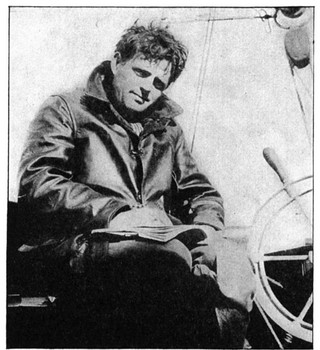
The Exciting and Predictable Worlds of Jack London


Jack London is dead. Okay, I'm late. He died in 1916 after a mere 40 years among us...or among them.

The review of a new biography of the man, Wolf: the Lives of Jack London by James L. Haley (Basic Books), caught my eye in the Economist. This should not surprise anyone since he has been a favorite writer for many boys, and I was no exception. I had a fondness for those northern adventure books, like Call of the Wild and White Fang. Farley Mowat's Lost in the Barrens was another one I remember well. Later, I moved on to Joseph Conrad. But enough about me.

What struck me about this fellow, London, is that on the one hand he wrote fine adventure novels that continue to thrill the young (they thrill my kids), writing on the basis of his grueling experiences on sealing ships and prospecting in the northern wastes.

Child Labourer, deckhand, gold prospector, hobo, and then forever a writer. And what a writer. Jack London was a hack who knocked out 1,000 words a day. His unceasing output fell into several categories: potboilers, high-calibre adventure novels, journalism (he served as a foreign correspondent for William Randolph Hearst during the Russo-Japanese war of 1904-05), and political screeds.
On the other hand he was totally captive to the intellectual fashions of his day. Does that sound like the literate left you know today? How about the glitterate left?

He was a socialist. But like most socialists, he was happy with capitalism and privilege when it served him personally. Obviously, he wrote and sold books for his own enrichment. I'm fine with that, but it doesn't sound like socialism. The reviewer also notes, however,  that "America's most famous socialist...travelled with an "obsequious Oriental valet" and bought yachts while claiming to speak for the working man."

At this point, I began suspecting that he was like so many celebrity leftists, who seem to attach themselves to every fashionable thought and cause. Sure enough. The reviewer tells us, "he was also a 'racialist' who believed in the superiority of the white race." It was popular at the time. What's next, I thought, spiritism and phrenology?

There is no word on phrenology (I may have my era confused on that one), but we learn next that his basket-case of a mother was indeed...a spiritist. Did London embrace it? No word on that either, but it fills out his world along predictable lines.

Like many great artists, however, he suffered much in his short life, and we have his art to show for it. More artists should stick to the craft of entertainment.

Wednesday, August 11, 2010

Tears for Our Children

This video montage, mostly of dad's coming home from service in Iraq and surprising their children (warning: you will cry), testifies to the depth of what children lose when divorce takes their fathers away or when they simply never know their fathers. It is a huge hole that nothing can fill. The Lord, our heavenly father, made us to have earthly fathers who love us and serve us with pure and manly love and whom we can love in turn with trust and devotion. Yes, Hanna Rosin, we will always need men, and we (I mean women and children) need them to be MEN.


Leon Kass, in his sad but marvelously illuminating 2002 essay, "The End of Courtship," evokes tears of a different sort with this description of what David L. Tubbs calls freedom's orphans:

The ubiquitous experience of divorce is also deadly for courtship and marriage. Some people try to argue, wishfully against the empirical evidence, that children of divorce will marry better than their parents because they know how important it is to choose well. But the deck is stacked against them. Not only are many of them frightened of marriage, in whose likely permanence they simply do not believe, but they are often maimed for love and intimacy.

They have had no successful models to imitate; worse, their capacity for trust and love has been severely crippled by the betrayal of the primal trust all children naturally repose in their parents, to provide that durable, reliable, and absolutely trustworthy haven of permanent and unconditional love in an otherwise often unloving and undependable world.

But we are too self-absorbed and pleasure saturated to care. We learn those pathologies as children, and perfect them as sexual consumers in the dollar store of young adulthood...or what Kay Hymowitz more accurately says has become "postmodern postadolescence."

For a challenging sermon on manhood, go to Rev. Benjamin Miller's sermons on SermonAudio.com, and look for "A Jesus Kind of Guy" (August 8, 2010). For many, regardless of your age, the road to manhood will lie on the other side of hearing this. The preacher is kind, but he is not gentle. Ben Miller pastors Franklin Square Orthodox Presbyterian Church on Long Island with Bill Shishko.

As a footnote, if anyone knows anything about the song on the video, please pass along the name of the artist and title.

Monday, August 9, 2010

The Progressive Project of Learned Feudalism

George Will gave this address to the Cato Institute on the occasion of receiving their Milton Friedman Prize for Advancing Liberty on May 13.

Fifty-one days ago the president signed into law health care reform, that great lunge to complete the New Deal project and the Great Society, that great lunge to make us more European. At exactly the moment that this is done the European Ponzi scheme of the social welfare state is being revealed for what it is.

There is a difference. We are not Europeans. We are not, in Orwell's phrase, a "state-broken people." We do not have a feudal background of subservience to the state. No, that is the project of the current administration - it can be boiled down to learned feudalism. It is a dependency agenda that I have been talking about ad nauseam.


Here is the podcast:


Read the print version of "Not a State-broken People."

Charles Murray spoke on this same subject to the American Enterprise Institute last year.

You might also read what David Brooks said at the same time.

Thursday, August 5, 2010

Jihad and Western Liberty

Whatever you may say about him personally (and I do), Newt Gingrich is brilliant, and is as politically insightful as the best among us.

At a recent address to the American Enterprise Institute, Gingrich argued that we need to reframe our understanding of the so-called War in Terror. That name distorts the nature of our present international conflict involving radical Islam.

It began not in 2001, but in 1979 with the Iranian revolution.

It has nothing to do with Gitmo, Israel, America's image in the world, or the presence of American troops in the Middle East. The essence of the conflict is the struggle on the part of radical Islamists to impose Sharia law universally. It is what their religion requires (as they understand it), and technology as well as culotural and political circumstances have opened the opportunity to make great strides toward that end.

It takes two forms: militant and stealth, i.e., the former using violence, and the latter using cultural, intellectual, and political means to achieve the same goal. Framing the conflict as a war on terror takes into account only the former. Iran is the locus of the militant effort. Saudi Arabia pushes the stealth agenda.


Watch the entire speech, "America at Risk: Camus, National Security, and Afghanistan."

Andrew McCarthy has an eloquent summary of the speech and the issue it addresses at NRO, "It's About Sharia: Newt Gingrich Resets Our National Security Debate."

He explains,

  • "The single purpose of this jihad is the imposition of sharia."
  • "Islam is not merely a religious doctrine, but a comprehensive socio-economic and political system."
  • "...the brutality in sharia sanctions is not gratuitous, but intentional: It is meant to enforce Allah’s will by striking example."
  • "It is thus entirely rational (albeit frightening to us) that they accept the scriptural instruction that the very existence of those who resist sharia is offensive to Allah, and that a powerful example must be made of those resisters in order to induce the submission of all — “submission” being the meaning of Islam."
  • "Islamism is not a movement to be engaged, it is an enemy to be defeated."
  • "By pressing the issue, Newt Gingrich...gives us a metric for determining whether those who would presume to lead us will fight or surrender."

Wednesday, August 4, 2010

No Great Gain without Failure

My colleague in the King's College business department, Brian Brenberg, recently published this great little piece on the First Things website: "Why We Need Failure."

Here's a taste:

Winston Churchill probably hated every one of the bumps that made his life’s road so inspiring. But he also knew that winning and losing are inseparable. “Success,” he said, “is going from failure to failure without losing your enthusiasm.” It’s not fun to fail, but it’s inevitable. Try as we might, we can’t get rid of failure in our lives unless we all agree to never get out of bed (and even that’s not without risk). The sooner you get used to dealing with things going wrong, the sooner you can get on with the business of finding ways to make things go right.
It is interesting to read the unqualified disaversion to failure in some of the comments on the article. Yes, some of our lives include terrible tragedy. That's not what Brenberg has in mind. ("So you say your three years old has eye cancer. Well, pick yourself up and learn from it!" Not the point.) Where do the complainers look for support? "Muscular unions." Where do they not look? There is not a word about God's loving providence.

Prompted by Brenberg's article, I offer my own reflections on failure and success at WORLDmag.com in "The Failures Behind American Success."

Brian Brenberg is assistant professor of business and economics at The King’s College in New York City. He holds degrees in public administration and in business from Harvard University.

Wednesday, July 28, 2010

The Left Loves Hobbes

In "Political Jeremiads" (WORLDmag.com, July 28, 2010), I review the fire and brimstone predictions of doom and call to political and cultural repentance that American political left has employed (and no doubt sincerely believed) over the last 40 years. In the 70s it was the population explosion and limits to growth. The 80s gave us the fear of thermonuclear exchange and (at best) the nuclear winter that would result. In the 90's, they schooled us in environmentalism to "save the planet." Our children were dished up "Captain Planet" on Saturday mornings. Seriously. But saving the planet was taken to a much higher level of alarm in this past decade with the global warming scare.

It's always, "Flee from the terrible wrath to come!" Where else, but into the arms of almighty state, whether American or global…preferably global. Even unilateral surrender was, in the eyes of some, the only safe option. Better red than dead, they used to say.

But what we hear continually is an interesting combination of secularized Christian hellfire preaching and Thomas Hobbes.

Having led us in abandoning God to make our way in the world by our own wits, the secular left has come to see terrors on every side. But instead of returning to God, the rock of ages and shelter from the storm, they call us to seek refuge under the shadow of Leviathan, the almighty state, which 17th century philosopher Thomas Hobbes called “that mortal god to which we owe, under the immortal God, our peace and defence.” They reject as absurd the notion that God governs all the affairs of men with perfect goodness, yet they seek to establish a human government that will administer all the affairs of men with perfect efficiency, foresight, benevolence, and justice.
Thomas Hobbes argued in the 17th century that when faced with an intolerable threat, conditions that will make life “solitary, poor, nasty, brutish, and short,” the only rational course is to surrender up your liberties to an all powerful government that will preserve what is most important: your life.


The only way to erect such a common power, as may be able to defend them from the invasion of foreigners, and the injuries of one another…is to confer all their power and strength upon one man, or upon one assembly of men, that may reduce all their wills, by plurality of voices, unto one will. …This is the generation of that great Leviathan, or rather, to speak more reverently, of that mortal god to which we owe, under the immortal God, our peace and defence.

In the course of preparing this column, I was charmed to notice that while during the limits to growth 70s, Frances Moore Lappé gave us Diet for a Small Planet (1971), now into the climate scare decade her daughter Anna Lappé has given us Diet for Hot Planet.

I was prompted to write on this topic by Ross Douthat's New York Times column, "The Right and the Climate," (July 25, 2010).

Thursday, July 22, 2010

The Defense of Intangible Property

I recieved this comment from someone named "RSD" on my column at WORLDmag.com, "Liberty, Justice, and Shopping." The political preconditions and consequences of specifically intangible property is an interesting topic for reflection.

Like you, I’m thankful for Amazon, and join you in viewing it as something of a model for how a market can function effectively. Part of its effectiveness is based on the fact that the traded entity is tangible. Tangibility lends to transparency, as reasonable people can generally assess whether or not a seller’s description is accurate. Further, it is difficult to exercise monopoly power over tangible property because the costs of maintaining the monopoly will eventually outstrip any monopoly-derived profits. (Consider, for example, Judge Hand’s analysis in the Alcoa case.)

Our financial markets, in contrast, revolve around intangible property, i.e., forms of property that have no intrinsic value outside of a legal/institutional framework that vests rights in them. Thus, transparency is not as straightforward. Further, monopoly is more readily achieved, as there is generally no added cost to maintain the monopoly.

It’s worth noting, therefore, that there is no such thing as intangible property, in general, without the willingness of the government to intervene for the benefit of those who possess rights in intangible property under the law. Thus, it’s not unreasonable also to expect government to ask, in exchange for such protections, that submit themselves to regulations that attempt to force intangible-property markets to mimic, as closely as possible, the features of tangible-property markets. ...
RSD goes on to distinguish between "the lazy rich" who reap rewards disproportionate to any "superior skill, foresight, and industry" they once may have exercised, if at all, and those who do exercise these. Laws that favor these "lazy rich" introduce economic injustice and distortions in the economy, and discourage innovation by those with "superior skill, foresight, and industry."

While wealth may be a better indicator of such than poverty, the ideal market, like the one on Amazon, should be no respecter of one’s current economic status. If the market is working effectively, the wealthy should lose much of their wealth as soon as they stop exercising superior skill, foresight, and industry.


The entire comment, #5 on the thread, is worth a read.

I responded, "I like your oft repeated phrase, “skill, foresight, and industry.” Francis Bacon, my chief research interest, exalts people with these qualities, and deprecates “the lazy rich” in the aristocracy. Bacon was one of the great architects of modernity, and prepared significant foundations for modern economic thinking in his Essays."

Wednesday, July 21, 2010

The Political Economy of Shopping

Excerpted from my WORLDmag.com column, "Liberty, Justice, and Shopping."


...This summer, I have been researching a project. As I have not been at the college much, the library has not been at hand. So I went to Amazon.com to see what the market was charging for the titles I needed. Then the fun began! For the last month I have been delighting myself buying a steady trickle of books for prices that thrill a Scotsman's heart. For just $4, I bought George Gilder's 1980 classic, Wealth and Poverty...in hardcover...with a dust jacket...not a mark in it...delivered to my door. ...

What has this to do with liberty? In this commonplace experience, I notice three examples of the justice and goodness that ordered liberty allows, in this case, through a free market.

First, the market provides broadly for people's needs. ...

Second, the market is not a respecter of persons. ...

Finally, the market provides a kind of distributive justice. ...

Liberty as exercised in an ordered but free marketplace is part of God's good design for human well-being. It's just a part. It's not sufficient on its own. But no discussion of its shortcomings can proceed in fairness without first recognizing these great goods.

Someone has recommended Bookfinder.com in place of Amazon. I'm always happy to introduce competition into the marketplace, especially when someone starts looking like a monopoly.

Thursday, July 15, 2010

Wallis and the Tea Party Infidels


In account of a recent writing project, I have been forced to pay attention to left wing Evangelicalism. Others also have been giving them new attention, from the Emerging church movement to save-the-planet young born again greenies to the religiously oriented in the Obama White House.

But Jim Wallis, one of the grand old men of the movement, seems anxious that Christ's little lambs not wander into what he sees as the hellish Tea Party movement, especially now that the pearly gates of access to his Progressive Kingdom are now flung wide. He gave voice to his frustration in his Huffington Post article, "How Christian is Tea Party Libertarianism?" I examine it in my WORLDmag.com column, "The Tea Party According to Jim Wallis."

To what I say at WORLDmag, I will add that he attacks the rights-oriented thinking that is the basis of our constitution. “Libertarianism is a political philosophy that holds individual rights as its supreme value and considers government the major obstacle.” But, of course, that’s what rights are: limitations on government. “Congress shall make no law…”

Especially disturbing is his charge that Tea Party supporters are racists in general, and in particular people who simply cannot abide the fact that our president is black. In lieu of actually engaging in a substantive debate over the merits of big government versus private initiative, the left is scolding their opponents with the racist charge. But the charge is baseless. A month later, a USA Today/Gallup poll showed that 23% of Tea Party supporters are Asian, Hispanic, and African-American.

But what if they weren’t? The best argument he can lob at the Tea Party itself is an ad hominem one, i.e., not an argument at all. The red elephant in the room, however, the subject he completely ignores, is the Tea Party alarm over stratospheric federal deficit spending, a concern that is reasonable, arguably Christian (eighth commandment), and fundamental to the movement.

I conclude,

Despite Jim Wallis’s self-presentation as a man who has thought through Christian principles and found himself in prophetic stance against what most Evangelicals hold to be just, his condemnation of the Tea Party movement (disguised as a conversation starter) is a muddled-headed confusion of terms and a battle entirely with straw men. I was hoping to be challenged. I was not.

Additional material:

Mark Tooley of the Institute on Religion and Democracy looks at the article here.

Timothy Dalrymple at Patheos gives us this.

Doug Wilson has not been silent. (That's a joke.) He weighs in here.

Prof. Craig Carter of Tyndale University in Toronto says this.

In a recent Washington Times article, "Netherlands Tragedy of State Compassion,"I argue that compassionate government (as if that were possible) makes people themselves less compassionate.

You might also consider Grover Norquist's book, Leave Us Alone: Getting the Government's Hands Off Our Money, Our Guns, Our Lives," (Harper Collins, 2008).

Also,

Anthony Bradley sees politically activist liberal Protestantism, with which leftist Evangelicalism seems to blend so easily, as understanding "one part of Christian engagement to be the whole of Christian identity," ("Progressive Christianity," WORLDmag.com, July 21, 2010).

Wednesday, July 14, 2010

Anthony Bradley on Beck

Anthony Bradley, my colleague at The King's College, was on the Glenn Beck Show yesterday explaining black liberation theology.

Beck takes most of the almost 18 minutes to talk about Marxism, BLT, and the gospel (more or less). Well, it's his show, right? Dr. Bradley comes in via satellite at the end.

Anthony Bradley's book is Liberating Black Theology (Crossway, 2010).


This is not Dr. Bradley's first time on Beck. Here he is in March 2008 just after the Jeremiah Wright eruption.


Here is Marvin Olasky interviewing Anthony Bradley when he was a visiting professor at the college.


You should also read Bradley's column today in WORLDmag.com, "Why Black Liberation Theology Fails."

Wednesday, July 7, 2010

Tea Party is No Moral Majority

The 1980 presidential election ended the way it did because Evangelical Christians got angry and got involved. In 2010, there is another very angry and highly organized movement that seems to be turning American politics on it's head: the Tea Party movement. Frantic liberals hate both of these popular revolts with such white-knuckled intensity that they easily identify them. (As in, "Oh, here come the backward, racist, Christian hillbillies again.") Jim Wallis, of Sojourners fame, seems particularly concerned that his secular leftist friends not get the idea that the Tea Party is Christian of any sort, so he tries to deep-six the idea in a Huffington Post article entitled, "How Christian is Tea Party Libertarianism?," (May 27, 2010).

In my WORLDmag.com column this week, "The Year of the Tea Party," I distinguish the Tea Party from the Moral Majority then show briefly that the Tea Party movement's much narrower agenda is arguably Christian at its core, or at least not unchristian.

The Moral Majority was intentionally a largely, but not necessarily, religious organization. It presented itself as a moral majority, not a Christian majority. Their concerns were threefold: family, foreign policy, and fiscal responsibility, if I may put it that way. Family issues included opposition to homosexuality, abortion, divorce, pornography, and feminism. Foreign policy concerns included standing effectively against world communism and supporting the state of Israel. To this they added a call for lower taxes and a balanced budget. The group’s agenda mirrored the GOP coalition of moral conservatives, foreign policy hawks, and fiscal conservatives, though the Moral Majority was chiefly concerned with family issues. There was an evangelical ministry called Focus on the Family, but nothing called Focus on Firepower or anything like that.

The Tea Party has a narrower agenda. It’s all about money. The movement was triggered by concerns over wild government spending, initially the implementation of TARP to stabilize the financial system, but then the group began to rally against various other stimulus packages, interventions, and pork barrel spending orgies that seemed to exploit the crisis to pillage several generations of taxpayers while the getting was good.

But money is not a dirty word. While balanced budgets are not the stuff of gospel preaching, financial responsibility is not an ungodly concern. In fact, concern for it is implied in the Eighth Commandment: “Thou shalt not steal!” Jim Wallis says, “[T]he Tea Party can legitimately be examined on the basis of Christian principles—and it should be,” then proceeds to attempt it. Yet he manages to overlook this feature that is arguably Christian and definitively Tea Party.

You can read more background on the Moral Majority in the WORLDmag.com column itself.

Saturday, July 3, 2010

The Tragedy of State Compassion

 The Spirit of Compassion Yet to Come

The Dutch are a fascinating people in so many ways. The Belgians must be ashamed by constant comparisons. My recent article with The Washington Times, "Netherlands' Tragedy of State Compassion: socialism undermines more than government solvency,"argues against he common identification of "compassionate society" with "socialist society" or even just "extensive social services."

This is a true account from a friend of mine on Long Island, but I have changed the names to preserve people's privacy.

Even young Mick Jagger, bless his heart, could see that it's hard getting old.

But Mrs. van Breda, at 90, is managing just fine. This is not because her two daughters and their husbands live just a five-minute walk from her apartment, which they do. Neither is it because her four grandchildren - three of them in their 20s - also live nearby. They offer little help because they don't have to: The van Bredas live in the Netherlands, a caring society. For this reason, Mrs. van Breda's course of life is smoothed by a welfare state that has institutionalized compassion. Quality of life is about more than just what you get, however. Much of it has to do with the relationships involved in the giving, relationships that even a caring government cannot deliver and even can destroy.

When her husband, Gert, died 13 years ago, Mrs. van Breda sold their house and moved into a government-subsidized apartment. The government sends a woman once a week to clean her apartment, but because she has the woman for up to four hours, Mrs. van Breda also has her do the grocery shopping. She pays something toward the cost of this help, but her contribution is based on her income - a government-funded pension - and so the service is highly subsidized.

Her daughter, Johanna, could easily help her with these tasks. In fact, Mrs. van Breda asked Johanna, who also cleans houses, if she would like to help in place of the state worker. It's better that the money benefit her family, after all. But Johanna said no: Why bother helping her mother when the government will do it?

When she developed arthritis, the state sent around someone to change the handles on all her doors and the taps on her faucets. In a less "compassionate" society, measured very narrowly by how much the government does, her sons-in-law or grandsons would swing by and take care of that sort of thing. But there is no need, and so they do not - and they would not.

Ironically, but perhaps not surprisingly, the Netherlands' "compassionate" social policy, with its preference for state provision, has made individual Dutch people less compassionate. A 2006 international study of charitable giving found that the supposedly less compassionate Americans individually gave 1.67 percent of the country's gross domestic product to charity. The Dutch gave just 0.45 percent, and the more moderate Canadians and British gave 0.72 percent and 0.73 percent respectively. Mrs. van Breda's expatriate son, Pieter, who lives in New York, notes that people have become personally unmindful of the needy as a result of these social-welfare policies. Personal relations are colder, he says, more businesslike, even within families.

The Dutch government serves Johanna's mother because it serves everyone, securing a minimal standard of living for all to enjoy. Through an array of birth-to-death social services that are either free of charge or subsidized according one's income, the state redistributes income widely. There is no reason for anyone in the Netherlands to be without a suitable home, to cut short his or her education anytime before senility or even to give any thought to feeding and clothing one's children. The Dutch have decided that a good society is a compassionate society, and so people should provide for one another's dignity and basic quality of life ... but only through the state. People needn't actually have anything to do with one another directly.

The Dutch state is said to be quite efficient in its delivery of services, and the Dutch people are happy with it. To be sure, neither Mrs. van Breda nor any of her children has any complaints. But this system comes at a human cost that its boosters must consider. My friend Pieter tells me that when it comes to serving the needy, regardless of the family relationship, the modern Dutch consider it enough that they pay taxes. In fact, they have come to bear a striking resemblance to none other than Ebenezer Scrooge in Dickens' "A Christmas Carol." Approached by two men who came collecting for the poor, he rebuffed them, asking, "Are there no prisons? Are there no workhouses?" Granted, Dutch provisions for those in need are on a level of humanity far higher than those Mr. Scrooge was satisfied with funding. But the spirit of personal indifference is the same. People simply don't want to be bothered, says Pieter - not even for their parents.

Daniel Henninger wrote recently in the Wall Street Journal, "One of the constant criticisms of Barack Obama's first year is that he's making us 'more like Europe.'" Those on the American political left are eagerly working to make us precisely that. They see our individualism as selfish and immoral, and they view our reliance on private charity as ineffective and degrading in comparison to government services and entitlements. The lesson of the Dutch experience, however, is not that the welfare state is the defining feature of a compassionate society, but that our choice in providing for those who are helpless and suffering is between the nanny state and a caring citizenry.
Henninger's article is "The We're-Not-Like-Europe Party," May 13, 2010.

A friend of recent Dutch descent shared this comment:

I am saddened by what has happened to the country of my father and grandfather.  We used to take pride in how industrious we were. The reason "Dutch cleanser" was called Dutch cleanser was that we Dutch people were ridiculously great housekeepers--they were clean freaks--scrubbing our stoops (yes, that is a Dutch name too) till they shined. I visited there a few years ago and hardly recognized it with all the filth. The government does not care about "clean"...and neither do the Dutch anymore.

I am sorry to hear about the filth. I have only heard about moral filth. I strongly suspect that it is closely related to the decline in personal responsibility. They have conquered the sea, but succumbed to the tide of nihilism. They are a tragedy, and in that is both a great compliment and an equally great lament. The North American Dutch have slouched in a different way toward their own Gomorrah. But there is still virtue in some of their communities here.

Friday, July 2, 2010

Dominion Day Forever

To all my friends in the Great White North, happy Dominion Day. (American friends, "white," here, refers to snow. Don't get upset.)

Canadian Flag, the Red Ensign, 1957-1965

On October 27, 1982, Parliament changed what I grew up celebrating as Dominion Day to "Canada Day." Liberals peddled the idea that "dominion" suggested "under the dominion of Great Britain." But it was nothing of the sort. Canada became what was called in the British Empire a dominion on July 1, 1867. It meant a self governing nation under Her Majesty's rule.

I have always viewed the name Canada Day with disdain. It is completely unimaginative. It has no content. It doesn't instruct the citizen in any way. I suspect that was the point. Celebrate Canada, giving that word whatever meaning you choose. That actually summarizes what the country has become in the last 40 years.

If the word "dominion" was just too utterly intolerable, they might have called it Confederation Day. That, after all, is what the day was always called in French Canada. It has historical reference, reminding the country of the great drama of how the country came together. It directs people to learn about the Fathers of Confederation, like Sir John A. Macdonald, their virtues and their statesmanship.

A CBC webpage reports that the bill changing the name of the day was passed by means of questionable legality. "Aside from its controversial content, the bill drew criticism over the manner in which it was passed in the House of Commons. It was voted through in five minutes with no debate, by the scant dozen members in attendance." The constitution at the time, the British North America Act of 1867 (which, in an Orwellian move, they have retroactively renamed the Constitution Act of 1867) required a quorum of 20 for Parliament to act.

Though I am now an American citizen, Canada is still my heritage, and July 1 will always be Dominion Day to me.

Thursday, July 1, 2010

Laffer Confirmed. It's a Lean Tomorrow.

Aha! (I love the sound of that.) This report confirms what Arthur Laffer says concerning misplaced incentives and the big economic come down we should expect next year.

Read "Pending Home Sales 'Fell Off a Cliff'" on CNNMoney.com.

The experts expected home sales to drop once the homebuyer tax credit lapsed at the end of April, but the depth of the decrease was shocking.

According to the National Association of Realtors (NAR), pending home sales fell a whopping 30% in May. Their index, which measures signed sales contracts but not closed sales, plunged to 77.6 from 110.9 in April. It's even off 15.9% from a year ago when the nation was barely emerging from the recession.

"The pending home sales report is a disaster," said Mike Larson, a real estate analyst for Weiss Research. "Sales fell off a cliff after the tax credit expired. It's the biggest monthly decline ever and the index is at its lowest level since NAR began tracking it in 2001."

Read my report on Arthur Laffer and others in the post below, or in "We're Doomed" at WORLDmag.com.

Wednesday, June 30, 2010

The 2011 Second Plunge Recession

Arthur Laffer makes a convincing and terrifying argument that we’re heading for an economic cliff next year. It’s going to happen. Make your plans accordingly.

"Tax Hikes and the 2011 Economic Collapse," Wall Street Journal, June 6, 2010. The subtitle: "Today's corporate profits reflect an income shift into 2010. These profits will tumble next year, preceded most likely by the stock market." When the cash for clunkers program was paying people significant incentives to buy cars, sales spiked. Lo! Incentives work! But when the program ended, sales plummeted. Much of the sales spike was just people shifting their purchase plans forward.

The same thing happened with the $8,000 that the government offered as an incentive last year for people to get out and buy a house. When the incentive ended, sales...you guessed it...plummeted. Much of what the publicly funded incentive either subsidized people who were buying anyway or concentrated in a shorter period of time sales that would have happened over a longer period. Undoubtedly it brought some people into the market who otherwise would not have entered, but Laffer's point is that the numbers are far overstated, and that we can see this in the collapse that followed the spike.

Now, consider that the Bush tax cuts are set to expire on January 1, 2011. Given that this Democratic Congress that grasps at people's money, but succeeds only at getting deeper into debt, has no plans to make those cuts permanent, people are doing what you can expect them to do in response to incentives and disincentives. They are using every means to move 2011 income into 2010, giving the misleading impression that the economy is recovering. But it's just a sugar high. 2011 will see a tremendous crash as a result of the massive tax hikes that are scheduled to hit the people who have money. Laffer details those taxes.

But, really. Obama's technocrats have it all figured out. They don't hand out Nobel Prizes like candy at a parade, you know. What could possibly go wrong? Here, Nassim Taleb, author of The Black Swan, his book on unexpected events (oh, say, housing bubble bursts, devastating oil spills, that sort of thing), has dark things to say about our economic situation and the people trying to steer us through it. Bloomberg reports that he considers President Obama "clueless."


As if that were not enough, the housing crisis is not over. The government, via the Federal Housing Administration, is fueling its continuation. Stephen Meister, in "The Next Disaster: Federal Mortgage Insurance," explains how.

In 2006, the FHA insured just 3 percent of home mortgages; today, it insures one of every three. Together with Fannie and Freddie, the FHA is putting the risk for the entire, $11 trillion US home-mortgage market on the back of the American taxpayer.

FHA also insures one in five refinances. Whereas private lenders--who are in the business of managing risk--are asking10-20 percent down when they lend at all, FHA requires as little as 3.5 percent down. As before, people in risky situations who really shouldn't be in the housing market are being facilitated into homes for political reasons, not market based ones. Also as before, many of them will default. But unlike the last time, the bulk of the loss will fall on the public treasury. That's a huge chunk of $11 trillion.

Thanks to the FHA, subprime-mortgage lending is alive and well. And thanks to Obama's latest program, private-mortgage investors will be able to pick the riskiest of their not-yet-defaulted underwater loans, and get them off their books and onto the FHA's. Bottom line: The Federal Housing Administration is continuing the toxic policies that produced the housing bubble and the subprime crisis, and putting the taxpayers on the hook for it. Expect it to be the next big bailout. 

Feeling down? Now meet the third Spirit of Crisis Yet to Come. Kevin Hassett of the American Enterprise Institute examines the Greek debt crisis and sees, if not an inevitably collapse, then at least a terribly brittle and shaky sovereign debt situation stretching from the east end of Europe to this side of the Atlantic. ("Greece's Bailout Heroes Arrive in Leaking Boats," Bloomberg Businessweek, May 16, 2010.

During the financial crisis, faith was restored in large financial institutions because toxic assets were essentially exchanged for government bonds. If government bonds become toxic, there will be no effective treatment options remaining. The collapse will have no bottom. And that collapse could happen at any moment.

Oh my. And our President is speaking to us from the Oval Office about energy-efficient windows.

A 2003 working paper by the International Monetary Fund puts in chilling perspective the debts we have been running  for the last couple of years.

The paper...studied historical sovereign-debt crises, exactly the situations that Western nations are hoping to avoid. They found that external debt levels -- money owed to foreigners -- exceeding 50 percent was a key indicator that debt default may occur. Here is the chilling fact: the average external debt as a percent of GDP among countries in their sample the year before a sovereign debt crisis was 54.7 percent, and 71.4 percent in the crisis year. The U.S. external debt on Dec. 31, 2009, was $13.77 trillion, or almost 100 percent of GDP. For much of Europe, the story is worse.

The lesson in each of these cases is that economics, something like physics, is unforgiving. There's no free lunch. Debts come due. You can put them off, but not indefinitely (though politicians like to fool us into thinking we can). The bigger you let them get and the longer you put them off, the deeper they bury you when they come back at you.

A more polished version of this appears at Worldmag.com under the title, "We're Doomed."